

Small businesses are real targets
It’s easy to assume attackers only go after big companies. In reality, most attacks are automated and opportunistic. They look for whoever is easiest to break into, and small businesses often make that list because they have valuable data, money to move and fewer defenses than a large enterprise.
The most common threats we see are not movie-style hacks. They’re everyday attacks that work because they’re simple:
- Phishing emails that trick someone into entering a password on a fake sign-in page.
- Business email compromise, where an attacker takes over a mailbox and quietly redirects an invoice payment or payroll deposit.
- Ransomware that encrypts your files and backups, then demands payment to unlock them.
- Stolen or reused passwords leaked from another website and tried against your accounts.
Good security doesn’t have to be complicated or expensive. It has to be layered, maintained and actually watched. That’s what our Dallas cybersecurity services deliver.
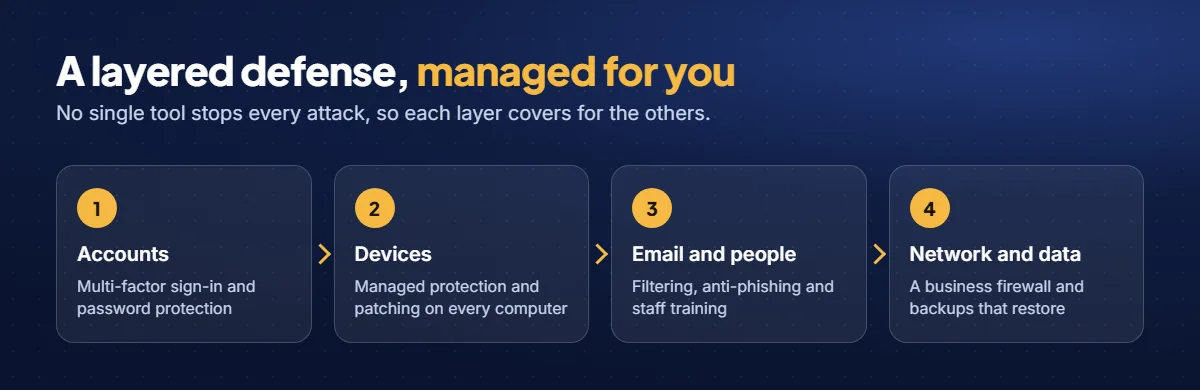
A layered defense, managed for you
No single product stops every attack. Instead, we put several layers in place so that if one fails, the next one catches it. Each layer is deployed, configured and kept up to date as part of your service.
Video transcript
Most small business cyberattacks aren’t movie-style hacks. They start with one fake email and one stolen password.
I’m Jason Osborne with SOHO Logics. We’re based in Sachse and protect small businesses in Wylie, Murphy, Garland and across Greater Dallas.
Attackers go after whoever is easiest to break into, and small businesses often make that list. No single tool stops everything, so we stack protection in layers. If one layer fails, the next one catches it.
First, your accounts. Multi-factor authentication means a stolen password alone isn’t enough to get in.
Second, your email and your people. Filtering catches bad links and attachments before they reach an inbox, and short, regular training helps your team spot the ones that slip through.
Third, your devices. Every managed computer gets protection that’s kept current. Where the risk calls for it, we add software that watches behavior, not just known viruses, and can isolate a computer that’s been compromised.
And fourth, backups that attackers can’t reach, tested regularly, so you can recover without paying a ransom.
It all starts with a free assessment. We look at who has access to what, whether multi-factor authentication really is everywhere, and whether your backups would survive ransomware. You get the answers in plain English. Book yours at sohologics.com or give us a call at 469 212 0545.
Protect your accounts
- Multi-factor authentication (MFA) on email, remote access and business applications, so a stolen password alone isn’t enough to get in.
- Sign-in policies that block risky logins, legacy protocols and access from places your business doesn’t operate.
- Dark web credential monitoring to alert you when company email addresses and passwords show up in known breaches.
Protect your devices
- Endpoint detection and response (EDR), which watches for suspicious behavior, not just known viruses, and can isolate a compromised computer.
- Patch management that keeps Windows, Mac and third-party applications current.
- Disk encryption so a lost or stolen laptop doesn’t become a data breach.
Protect your email and your people
- Email security and anti-phishing filtering that catches malicious links, attachments and impersonation attempts before they reach an inbox.
- Security awareness training and simulated phishing tests, so your team learns to spot and report the attacks that slip through.
- DNS filtering that blocks connections to known malicious websites, even when someone clicks the wrong link.
Protect your network and your data
- Firewall management, with secure configurations, current firmware and a guest Wi-Fi network kept separate from business systems.
- Backups that attackers can’t reach, with off-site, immutable copies and regular restore tests. Our backup and disaster recovery service covers this in detail.
For a closer look at how these layers work together, read Ransomware and the Small Business: 7 Layers of Protection That Actually Work.
Start with a security assessment
You can’t protect what you haven’t looked at. Every engagement starts with a review of your current environment: who has access to what, how devices are protected, how email is filtered, whether MFA is truly everywhere, and whether your backups would survive a ransomware attack.
You’ll get a plain-English summary of what we found, which gaps matter most, and what it would take to close them. The initial review is part of our free IT assessment, and there’s no obligation.
Businesses with compliance requirements
Some of our clients work under regulations or contracts that require specific safeguards, such as medical offices, financial and insurance firms, or businesses that process card payments. We put strong technical controls in place, like MFA, encryption, access management, logging and tested backups, and we document them clearly.
We are not a compliance or legal firm. For formal requirements like HIPAA or PCI, we work alongside your compliance consultant, auditor or attorney, who remains responsible for compliance guidance, and we help put their recommendations into practice.
Security is part of every plan
Security isn’t an upsell at SOHO Logics. Every managed IT plan includes managed endpoint protection and patching. Our Business and Premium plans add email security, anti-phishing protection and security awareness training. Additional layers, such as EDR, DNS filtering and dark web monitoring, are recommended based on your risk and included in your proposal after the assessment.
Cybersecurity for Sachse, Wylie and Murphy businesses
Many businesses in Sachse, Wylie and Murphy run from home offices, small suites and shops without an IT department, which makes them easy targets for phishing and stolen passwords. We are based in Sachse and set up multi-factor authentication, email security, managed antivirus and staff training for small teams across all three towns, working remotely where we can and on site when needed. Owners working from home can start with the home-office checklist on our Murphy page.
Frequently asked questions
We already have antivirus. Isn’t that enough?
Traditional antivirus looks for known threats. Modern attacks often use stolen passwords, legitimate tools or brand-new malware that antivirus doesn’t recognize. That’s why we layer MFA, email filtering, EDR, training and backups on top of it.
What is EDR?
Endpoint detection and response is security software that watches for suspicious behavior on each computer, such as a program suddenly encrypting files. It can stop the activity and isolate the device before the problem spreads.
What happens if we’re hit by an attack?
We move quickly to contain it: isolating affected devices, resetting compromised accounts and restoring clean data from backup. If you have cyber insurance, we coordinate with your carrier and any incident response firm they require.
Can you train our employees?
Yes. Security awareness training and simulated phishing emails are included in our Business and Premium plans. Short, regular lessons keep security top of mind without taking people away from their work.
Does better security slow people down?
It shouldn’t. Modern MFA takes a tap on a phone, and most protections run quietly in the background. We set things up so they’re secure and practical for the way your team actually works.
How can a small business protect itself from ransomware?
Layer your defenses: multi-factor authentication, prompt updates, endpoint protection that watches for suspicious behavior, email filtering, staff training, and backups that attackers can’t change, tested regularly. No single tool is enough, and tested backups are what let you recover without paying. See our seven layers of protection.
What cybersecurity does a small business actually need?
Most small businesses need the same core: MFA, current software, managed antivirus or endpoint protection, email security, security awareness training, backups and a plan for what to do after an incident. Our 12-point cybersecurity checklist lets you see where you stand.
What is multi-factor authentication, and do we need it?
Multi-factor authentication asks for a second proof, such as an approval on your phone, in addition to the password. A stolen password alone is then not enough to get in. It is one of the most effective and least expensive protections, and it is included with Microsoft 365 and Google Workspace. Read our MFA guide.
Can you check whether scammers can send email as my business?
Yes. Our free Email Security Checker grades your domain in about 10 seconds and explains the results in plain English. If it finds problems, we can fix the email settings (SPF, DKIM and DMARC) step by step, so legitimate email keeps flowing.
Do you provide cybersecurity services in Sachse, Plano and Frisco?
Yes. We are based in Sachse and provide cybersecurity for small businesses across Dallas and the northern suburbs, including Plano, Frisco, Richardson, Wylie, Murphy and Garland. We work alongside your compliance consultant or auditor if you have one.
